|
|
The Movement of the Dog |




The Movement of the DogBy Frank van Tatenhove,
The construction design of the dog is related to the origin of its function.Abstract: The movement of the dog; static, dynamics and how. Keywords: Movement, structure, bones, muscles. This article and view on the movement of dogs is based on my background in zoology, my education and observing canines in their natural environment. My introduction to the sport of dogs came very early in life, my family was involved in horses, cattle and dog breeding. I have always had a great passion for nature, especially for wild animals with a special interest in wolves and leopards. The maneuverability and speed at which a leopard brings down his prey has always fascinated me. This fascination lead to looking for answers to such questions as, "how can such an animal perform at such speed?; how is it possible that his muscles deliver such an energy to accelerate?" This technical dynamics is visible in many of our dogs, especially in the sight hound breeds. The dogs can turn and accelerate in a very short distance. The Genetic evolution of these breeds allowed them to develop special bone composition, structure, size and diameter allowing the tendons and muscles juncture space. The structure of the bone is designed for the high forces the body is subjected to when in motion. The mechanics (dynamics) in the sight hound breeds are mainly in the back, which delivers the energy and transmits this energy to the strong lumbar area. The lumbar is the bridge between the back and the rest of the body. The forearm also has a propulsion function, the broad dorsal muscle, (lattissimus dorsi) attaches from both sides of the body, and from the dorsal vertebra across the ribs to the inside of the upper arm and the breast muscle (pectorals) from sternum to the inside of the bow joint. These connections are responsible for the propulsion function. The broad dorsal muscle has a variable speed control system, the contractions and relaxing parts of the muscle are self-regulating. Years ago I hunted on the beaches and dunes with two friends, one owned an Irish Setter the other a Greyhound and I with my Afghan hounds all in competition for the hare. The competition between friends as to whom had the fastest and smartest dog lead to the following observation. The Greyhound had the top speed but his maneuvering capability was less than that of the Afghan, however, the Setter had the greatest endurance capability. Although balance and structure are important and do enhance performance did the Setter have a more inherent drive to perform the function? This lead to the following question; "What structure will provide the correct movement to achieve endurance and efficient gait for the hunting dog?" While pondering this question I would look for answers at dog show agility trials. There I was able to observe many different breeds working the trial's course. This day Border Collies make up the largest entry for any one breed in competition. The dogs climb the various structures and perform at high speeds, the dog that completes the course the fastest is considered the winner. The conformation (structure) of the dog plays an inherent role in
the speed at which he/she can maneuver the structures and obstacles and maintain balance
and speed. This applies for all breeds performing in sports such as obedience, hunting,
racing, and weight pulling These activities demonstrate their performing capability, however,
one may perform better than the other, and use his energy more efficiently, and this is
where a balanced in construction enters the picture. These dogs just glide
My Afghanhound "Achmed" in 1982 top racinghound in the Holland . At dog shows, breeds are sorted into specific groups, the groups are differentiated by their function, i.e., Sporting, Working, Terrier, Herding, Hound, Toys & Non-Sporting. Within these groups each breed is judged on its standard. Within each standard there are certain criteria that the dog should meet, movement, breed type & function receive the most emphasis.
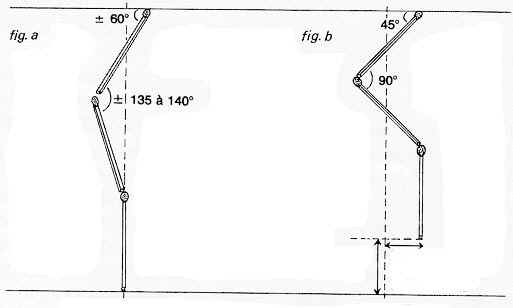
Differents in forehand; replacements by angulation vs leglenghts.
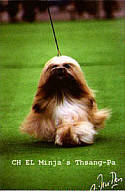
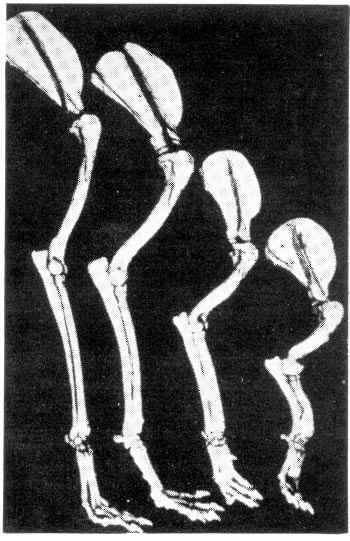
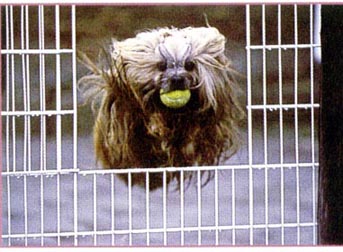
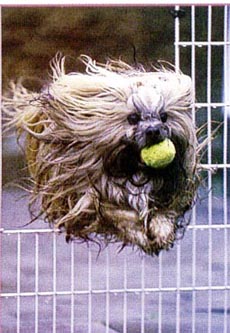
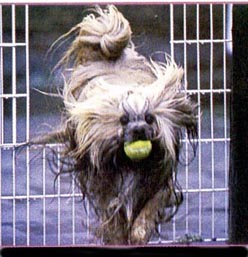
PH.D. Seiferle skeleton studies; left to right: Saluki, German Shepperd, English Bulldog, Bassethound. Under Lhasa Apso in action,
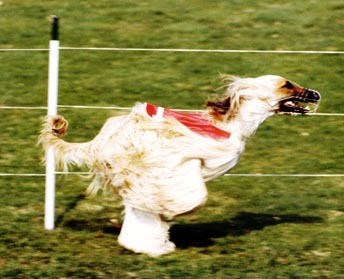
Show Champion EL Minja's Mahakala in action at agillity cours! Important researchers on this science are Mrs. Rachel Page Elliot author of the book "Dog Steps and the New Dog Steps"; Dr. Curtis Brown author of many books about locomotion in the dog. Another important author is Prof Seiflerle from Switzerland, years
before World War II he stated that a 45* shoulder angle was impossible and proved it with
his scientific work and skeletons.
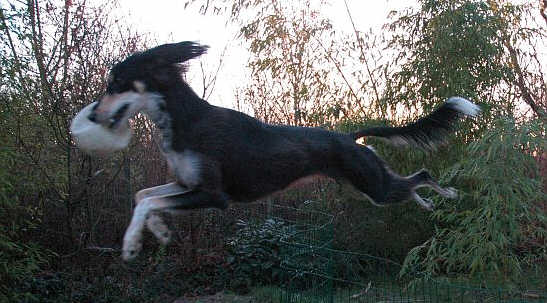
Saluki Dalihra owned by family Durr in action ,
First printed 1986,reprint 1990, 1992,2000 Published by Intercanis 1996 Other articles by Frank van Tatenhove are: Zootechnique, breeding, mutations, hipdysplasia, moleculair-genetics,diseases of the eye.
|
© Frank van Tatenhove
First printed 1986,reprint 1990, 1992,2000
Published by Intercanis 1996
Other articles by Frank van Tatenhove are:
Zootechnique, breeding, mutations, hipdysplasia, moleculair-genetics,diseases of the eye.
 Top
I copyright,legal
and email statement
Top
I copyright,legal
and email statement